Quick Answer: Therapist and counsellor websites in Stockport need to balance three things simultaneously: watertight privacy compliance, a design that builds genuine client trust, and local SEO that gets the right people through the virtual door. Get all three right and the website works around the clock to bring in new clients. Miss any one of them and the whole thing falls flat.
Key Takeaways
- Therapy websites handle sensitive personal data, so GDPR compliance and SSL encryption are non-negotiable, not optional extras.
- Trust signals — professional photography, clear credentials, and honest copy — directly influence whether a potential client picks up the phone.
- Local SEO for Stockport therapists means targeting area-specific search terms, not just generic mental health keywords.
- A mobile-first, fast-loading website is essential because most people search for a therapist on their phone.
- A clear privacy policy and a secure contact form reduce anxiety for clients who are already in a vulnerable state.
- Google’s E-E-A-T framework (Experience, Expertise, Authoritativeness, Trustworthiness) rewards therapy websites that demonstrate real credentials.
- A thoughtfully designed website is a long-term business asset, not a one-time expense.
Why Do Therapist and Counsellor Websites in Stockport Need a Different Approach?
Mental health websites are not like a plumber’s website or a café’s landing page. They serve people who are often anxious, vulnerable, and making a deeply personal decision. That context changes everything about how the site should be built, written, and found.
A Stockport therapist’s website must do three things well at once:
- Protect client privacy from the first click to the final form submission.
- Build trust before a single word has been exchanged in person.
- Rank locally so the right people in Stockport, Heaton Moor, Cheadle, or Bramhall can actually find the practice.
This is a more considered brief than most small business websites carry. It demands a smarter way of thinking about design, content, and technical setup.
What Privacy Obligations Apply to Therapy Websites in the UK?
UK therapists are subject to GDPR and the Data Protection Act 2018. Any website that collects personal data — including names, email addresses, or details shared through a contact form — must handle that data lawfully and transparently.
The essentials every therapy website needs:
| Requirement | What It Means in Practice |
|---|---|
| SSL Certificate (HTTPS) | All data transmitted through the site is encrypted |
| Privacy Policy | A clear, plain-English document explaining what data is collected and why |
| Cookie Consent | A compliant banner that lets users accept or decline non-essential cookies |
| Secure Contact Form | Form submissions must be encrypted and stored securely |
| Data Retention Policy | A stated policy on how long client enquiry data is kept |
A missing privacy policy or an unsecured contact form does not just create legal risk. It signals to a potential client that the practice is not careful with sensitive information. For a therapist, that is a trust-breaking detail.
Common mistake: Many therapists use a generic website template with a pre-filled privacy policy that references the wrong country’s laws or an outdated framework. Always have a UK-specific, GDPR-compliant policy reviewed regularly.
How Does Website Design Build Trust for Stockport Counsellors?
Trust is built before the first session. A potential client will spend time on a therapist’s website deciding whether this person feels safe, credible, and right for them. The design either supports that decision or undermines it.
Trust signals that genuinely work:
- A professional photograph of the therapist. Not a stock image. Real, warm, and approachable.
- Clear professional credentials — BACP, UKCP, or COSCA membership displayed prominently.
- Testimonials, where ethically appropriate and anonymised.
- A clear explanation of the therapy approach in plain, accessible language.
- Easy-to-find contact information with no friction.
- A calm, clean visual design that reflects the nature of the work.
Colour psychology matters here too. Soft blues, greens, and warm neutrals communicate calm and safety. A cluttered, busy layout does the opposite.
For user trust and user experience, the design should feel like the waiting room: quiet, considered, and welcoming.
What SEO Strategies Work Best for Therapist Websites in Stockport?
Local SEO is the engine that brings new clients to a therapy website. Most people searching for a therapist type something like “counsellor near me” or “anxiety therapist Stockport” into Google. The website needs to show up for those searches.
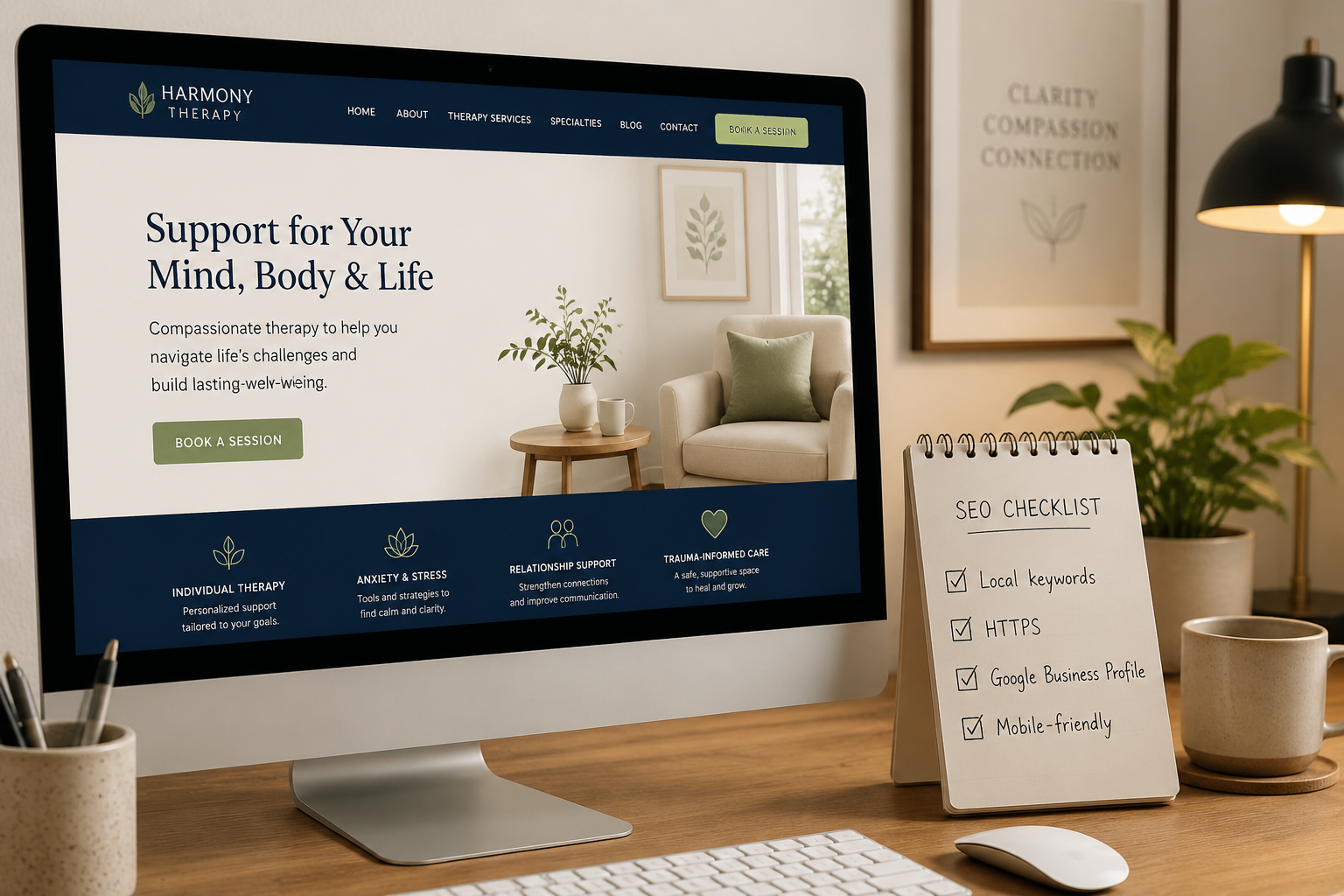
Core local SEO actions for Stockport therapists:
- Claim and optimise a Google Business Profile with accurate address, opening hours, and a link to the website.
- Target location-specific keywords such as “therapist in Stockport,” “CBT counsellor Heaton Moor,” or “bereavement counselling Cheadle.”
- Write service pages for each therapy type offered, not just one generic “services” page.
- Build local citations by listing the practice on directories like Psychology Today, Counselling Directory, and local Stockport business listings.
- Earn backlinks from relevant local organisations, GP surgery directories, or mental health charities.
- Publish helpful blog content that answers common questions — for example, “What is the difference between CBT and person-centred therapy?” This builds authority and captures long-tail search traffic.
For a deeper look at top local SEO services and strategies, iindigo’s resources are a useful starting point.
Choose local SEO if: the practice primarily serves clients within a 10-15 mile radius of Stockport. Generic national keywords are too competitive and attract the wrong audience.
What Technical Features Should a Therapy Website Include?
A thoughtfully designed therapy website is not just about aesthetics. The technical foundation determines how fast it loads, how it ranks, and how secure it is for visitors.
Technical checklist for therapy websites:
- ✅ HTTPS / SSL certificate active
- ✅ Mobile-responsive design (most therapy searches happen on mobile)
- ✅ Page load speed under 3 seconds
- ✅ Secure, encrypted contact and booking forms
- ✅ Clear meta titles and descriptions for each page
- ✅ Structured data markup (schema) for local business
- ✅ Accessible design (WCAG 2.1 AA compliance where possible)
- ✅ Regular software and plugin updates
WordPress is a strong platform choice for therapy websites. It is flexible, well-supported, and — when built correctly — highly secure. For guidance on what type of website fits a small practice, the answer usually depends on how many services are offered and whether online booking is needed.
Responsive websites are not optional for therapy practices in 2026. A site that does not work on a smartphone will lose clients before they ever make contact.
How Does Google’s E-E-A-T Framework Apply to Counsellor Websites?
Google’s E-E-A-T guidelines — Experience, Expertise, Authoritativeness, Trustworthiness — are particularly relevant for health and wellbeing websites, which Google classifies as “Your Money or Your Life” (YMYL) content. This means Google holds these sites to a higher standard.
What E-E-A-T means for a Stockport therapist’s website:
- Experience: Write content that reflects real clinical experience. Share genuine insights, not generic advice copied from elsewhere.
- Expertise: Display qualifications, training, and professional memberships clearly.
- Authoritativeness: Get listed on reputable directories and earn mentions from credible local sources.
- Trustworthiness: Maintain an accurate, up-to-date website with a clear privacy policy and secure forms.
A therapist who blogs regularly about their specialist areas — anxiety, trauma, relationships — builds E-E-A-T over time. This is a smarter way to compete against larger directories that dominate generic search terms.
For effective on-page SEO strategies that support E-E-A-T, the focus should always be on depth and accuracy, not keyword density.
What Does a Well-Built Therapy Website Cost in Stockport?
Costs vary depending on the scope of the project. A starter website for a sole-practitioner therapist is different from a multi-therapist practice site with online booking integration.
Rough cost guide (2026 estimates):
| Website Type | Typical Setup Cost | Monthly Ongoing Cost |
|---|---|---|
| Starter (1-3 pages) | £500 – £1,200 | £30 – £60 |
| WordPress (up to 10 pages) | £1,200 – £3,000 | £50 – £100 |
| Growth-focused with SEO | £2,500+ | £100 – £250+ |
These figures are estimates based on typical Stockport web design agency pricing. Actual quotes will depend on specific requirements.
The monthly cost covers hosting, security updates, and maintenance — all of which matter more for a therapy website than most, given the privacy obligations involved.
For businesses ready to grow, finding the best web designers in Stockport is a practical first step before committing to a budget.
How Should a Therapy Website Handle Online Booking and Contact?
The contact process is the most sensitive part of a therapy website. A potential client reaching out for the first time is often doing something that took courage. The experience must feel safe, simple, and private.
Best practice for therapy website contact:
- Offer multiple contact options — phone, email, and a secure form — without making any feel mandatory.
- Keep the contact form short. Name, email, and a brief message is enough. Do not ask for detailed mental health history in a web form.
- Include a brief reassurance statement near the form: something like “All enquiries are treated in strict confidence.”
- If using an online booking system, ensure it is GDPR-compliant and clearly branded to avoid confusion.
- Avoid using standard Gmail or Hotmail addresses for professional enquiries. A branded email address (e.g., [email protected]) signals professionalism.
This is where community trust and customer trust converge. The smallest details — a reassuring sentence, a secure padlock icon — carry real weight for someone in a vulnerable moment.
FAQ: Therapist and Counsellor Websites in Stockport
Do I need a separate privacy policy for my therapy website?
Yes. A GDPR-compliant privacy policy is a legal requirement for any UK website that collects personal data. It should be specific to your practice, not a generic template.
Can I use client testimonials on my therapy website?
Yes, but carefully. Testimonials should be anonymised and clients should give explicit consent for their words to be used. Check your professional body’s guidelines — BACP and UKCP both have specific advice on this.
How long does it take to rank on Google as a Stockport therapist?
Local SEO results typically take three to six months to build. A well-optimised Google Business Profile can show results faster, sometimes within weeks.
Is WordPress a good choice for a therapy website?
Yes. WordPress is flexible, secure when maintained properly, and well-suited to the kind of content-rich, multi-page websites that perform well in local search.
Do I need a blog on my therapy website?
Not immediately, but it helps. Regular, relevant blog content builds authority, improves SEO, and gives potential clients a sense of your approach before they make contact.
What is the most important trust signal on a therapy website?
A genuine, professional photograph of the therapist. Clients are choosing a person, not a service. Showing a real face builds connection before the first session.
Should my therapy website be mobile-friendly?
Absolutely. The majority of local searches happen on mobile devices. A site that does not display correctly on a smartphone will lose potential clients immediately.
What makes a therapy website different from other small business websites?
The audience is often in a vulnerable state, the data collected is sensitive, and Google holds health-related websites to a higher standard. Privacy, empathy, and credibility matter more here than in most other sectors.
Conclusion: Build It Right, and It Works for You
A therapy or counselling website in Stockport is not just a digital brochure. When it is built with confidence in every detail — privacy-compliant, trust-building, and locally optimised — it becomes a reliable and refined tool that brings the right clients to the right practice, quietly and consistently.
Actionable next steps:
- Audit your current website for SSL, privacy policy, and mobile responsiveness.
- Claim your Google Business Profile and ensure the address, phone number, and category are accurate.
- Review your contact form — is it secure, simple, and reassuring?
- Identify two or three local keyword phrases relevant to your specialism and location.
- Speak to a local web designer who understands both the technical and the human side of building a therapy website.
iindigo, based in Heaton Moor, Stockport, works with small business owners across the area to create websites that are distinctive by design and built around the real needs of the business and its clients. For therapy practices, that means getting privacy, trust, and SEO right from day one.
References
- Information Commissioner’s Office (ICO). Guide to the UK GDPR. ico.org.uk. 2021.
- British Association for Counselling and Psychotherapy (BACP). Ethical Framework for the Counselling Professions. bacp.co.uk. 2018.
- Google Search Central. Creating helpful, reliable, people-first content. developers.google.com. 2022.
- UK Government. Data Protection Act 2018. legislation.gov.uk. 2018.