


Quick Answer: A well-built website is now the single most important sales tool for personal trainers and gym owners in Stockport. The best fitness websites combine frictionless online booking, clearly presented membership plans, and visible trust signals — all working together to turn casual visitors into paying clients. Get any one of these wrong and potential customers will simply choose a competitor.
Key Takeaways
- Online booking is non-negotiable. Clients expect to book sessions 24/7 without picking up the phone.
- Pricing transparency builds confidence. Hiding your plans costs you enquiries.
- Trust signals — reviews, qualifications, photos — do the heavy lifting before a client ever contacts you.
- A thoughtfully designed fitness website should load fast, work perfectly on mobile, and guide visitors toward a clear action.
- Local SEO matters enormously. Stockport gym and trainer searches are hyper-local — your site needs to reflect that.
- Starter websites work for solo trainers; growing gyms need more pages, more functionality, and a smarter content strategy.
- A reliable web partner handles hosting, updates, and security so you can focus on clients.

Why Personal Trainer and Gym Websites in Stockport Need More Than Good Looks
A fitness website that only looks attractive is a missed opportunity. The goal is simple: convert visitors into booked clients. For personal trainers and gym owners across Stockport — from Heaton Moor to Bramhall — that means building a site around three pillars: booking ease, plan clarity, and earned trust.
Most fitness businesses in Stockport already understand that their website matters. The gap is in execution. A site that buries its booking button, hides its prices, or lacks any social proof will consistently underperform — regardless of how polished the design feels.
“Your website works for you at 11pm on a Tuesday. Make sure it’s doing the job properly.”
The good news? These problems are entirely fixable. And for small fitness businesses, solving them has a direct, measurable impact on revenue.
What Makes an Effective Booking System for Fitness Websites?
The best booking systems are visible, fast, and require minimal steps. A client should be able to find your booking option within seconds of landing on your site — not after scrolling through three pages of content.
Here’s what a strong booking setup looks like for Stockport personal trainers and gyms:
- Prominent placement: A “Book a Session” button in the navigation and above the fold on the homepage.
- Mobile-first design: Most fitness searches happen on phones. The booking flow must work flawlessly on a small screen. See how responsive sites can transform user experience.
- Minimal friction: Fewer form fields mean more completions. Ask only for what’s essential.
- Instant confirmation: Automated email or SMS confirmation builds immediate confidence.
- Calendar integration: Real-time availability prevents double-bookings and back-and-forth messages.
Common mistake: Linking to a third-party booking platform that looks completely different from your website. This creates a jarring experience and erodes trust at the exact moment a client is ready to commit.
Choose an embedded booking tool if your sessions are regular and structured. Use a simple contact form if your service is highly bespoke and requires a consultation first.
How Should Gyms and Trainers Present Their Plans and Pricing?
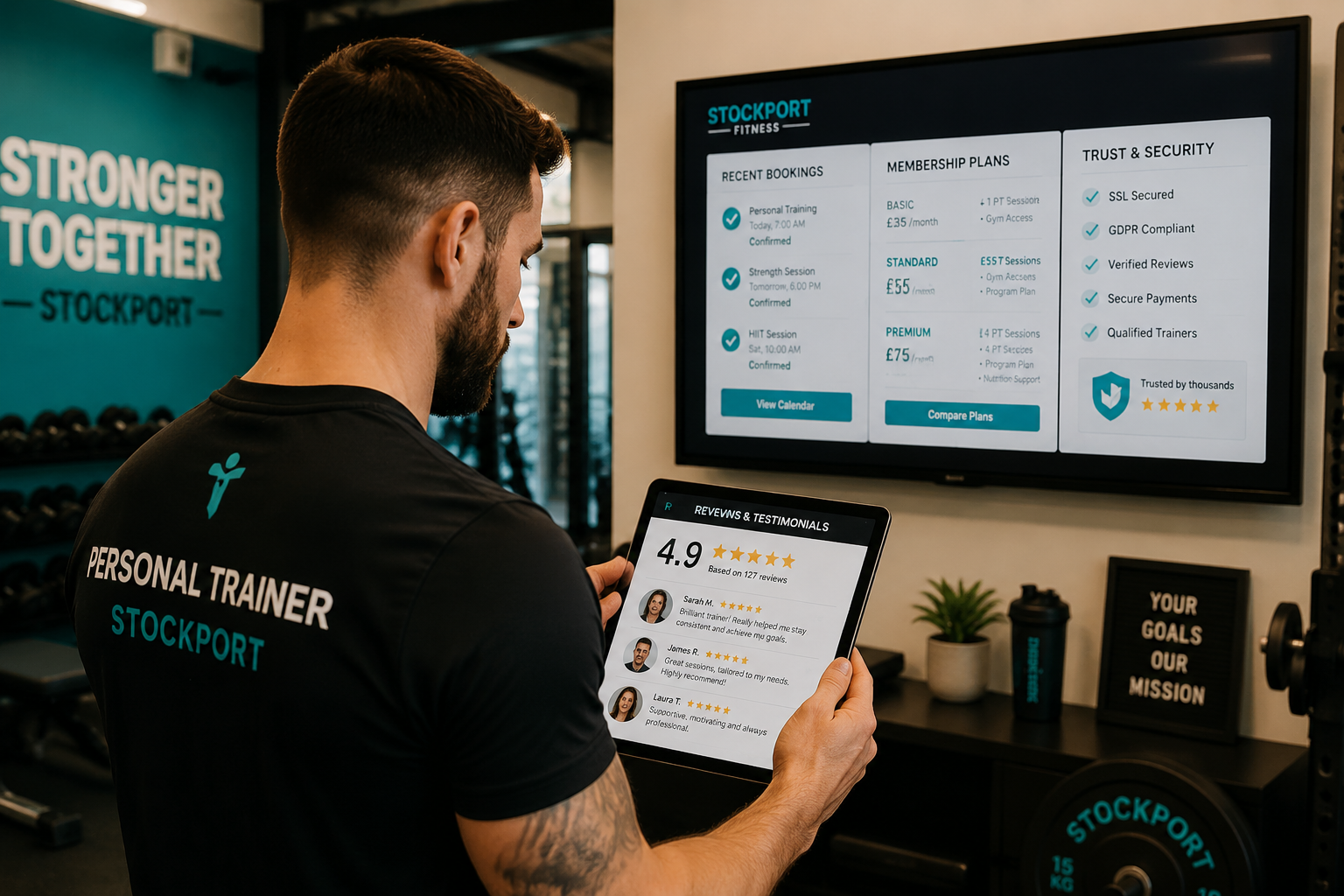
Pricing transparency is one of the highest-impact trust signals on any fitness website. Hiding your rates forces potential clients to enquire before they’re ready — and many simply won’t bother.
| Plan Type | What to Show | What to Avoid |
|---|---|---|
| Monthly memberships | Full price, what’s included, any contract terms | “Contact us for pricing” |
| Personal training packages | Per-session vs. block rates, savings | Vague “from £X” without detail |
| Online coaching | Monthly fee, what’s delivered, cancellation policy | Lengthy terms buried in small print |
| Free trials / tasters | Clear duration, what happens next | Hidden upsell surprises |
Presentation tips for fitness pricing pages:
- Use a simple three-column layout (Starter, Standard, Premium works well).
- Highlight the most popular plan visually.
- Include a short sentence on each plan explaining who it’s best suited for.
- Add a FAQ below the pricing table to address common objections.
For solo personal trainers just starting out, understanding what type of website you actually need is a smart first step before investing in complex pricing structures.
What Trust Signals Matter Most on Fitness Websites in Stockport?
Trust is built before a client picks up the phone. On a fitness website, trust signals are the elements that answer the question: “Is this person or gym genuinely good?”
The most effective trust signals for Stockport fitness businesses:
- Client testimonials — Real names, real photos where possible. Video testimonials are even stronger.
- Qualifications and certifications — Display your Level 3 PT qualification, REPs registration, or any specialist certifications clearly.
- Before and after results — With client permission, these are powerful proof of outcomes.
- Google reviews — Embed or link to your Google Business profile. A 4.5-star rating with 30+ reviews is credible. Fewer than 10 reviews looks thin.
- Professional photography — Blurry gym photos or stock images of generic fitness models undermine authenticity immediately.
- A clear “About” section — People hire people. A genuine, warm introduction builds connection.
For more on building customer trust through your digital presence, the principles apply directly to fitness businesses of any size.
Edge case: If you’re a brand-new trainer without testimonials yet, lead with your qualifications, your personal fitness story, and offer a free taster session to start generating social proof quickly.
How Does Local SEO Help Stockport Gyms and Trainers Get Found?
Local SEO determines whether your fitness business appears when someone in Stockport searches “personal trainer near me” or “gym in Heaton Moor.” Without it, even the most beautifully designed website sits invisible.
Key local SEO actions for fitness websites:
- Google Business Profile: Claim, verify, and fully complete it. Add photos, services, and respond to every review.
- Location-specific pages: If you serve Cheadle, Bramhall, or Cheadle Stockport areas, mention them naturally in your content.
- Page titles and meta descriptions: Include “personal trainer Stockport” or “gym Stockport” in your homepage title.
- Consistent NAP: Your Name, Address, and Phone number must match exactly across your website, Google, and any directories.
- Blog content: Articles like “5 Best Running Routes in Stockport” or “How to Stay Fit During a Stockport Winter” build local relevance over time.
Effective on-page SEO strategies applied consistently will compound over months, pushing your fitness business higher in local search results.
What Pages Does a Personal Trainer Website in Stockport Actually Need?
A focused, well-structured site outperforms a sprawling one every time. For most solo personal trainers in Stockport, five to six pages is enough to convert visitors effectively.
Essential pages:
- Home — Clear headline, booking CTA, brief intro, social proof snippet.
- About — Your story, qualifications, training philosophy.
- Services / Plans — What you offer, who it’s for, pricing.
- Testimonials / Results — Dedicated social proof page.
- Blog — Local content and fitness advice to support SEO.
- Contact / Book — Simple form or embedded booking tool.
For gyms with multiple trainers or class timetables, a WordPress site offers the flexibility needed. Read more about taking your personal training business online for a practical starting point.
A user-friendly website isn’t a luxury for fitness businesses — it’s the difference between a full client roster and an empty diary.
How Much Should a Stockport Fitness Business Spend on a Website?
Website costs for personal trainers and gyms in Stockport typically split into a one-time setup fee and a monthly hosting and maintenance charge. There’s no single right number — it depends on what you need.
A rough guide:
- Starter site (1–3 pages): Ideal for a new solo trainer. Gets your brand established quickly, low upfront cost.
- WordPress site (up to 10 pages): Better for gyms, trainers with multiple services, or anyone who wants to blog and build SEO over time.
- Growth-focused package: Includes a high-converting website, SEO, CRM, and ongoing brand-building. Best for fitness businesses serious about scaling.
The monthly charge covers hosting, security updates, and maintenance — so your site stays fast, secure, and working around the clock without you lifting a finger.
Decision rule: Choose a starter site if you’re testing the market or just launching. Invest in a fuller WordPress build once you have a clear service offering and are ready to grow your client base through search.
FAQ: Personal Trainer and Gym Websites in Stockport
Q: Do I need online booking on my fitness website from day one?
Yes. Even a simple embedded form that captures name, preferred time, and contact details is better than nothing. Clients expect to initiate contact online.
Q: Should I show my prices on my website?
Yes, in almost every case. Transparency reduces friction and filters out poor-fit enquiries, saving you time.
Q: How long does it take to build a personal trainer website?
A focused build typically takes around 30 days from brief to launch, assuming you provide content and photos promptly.
Q: Can I manage my own website after it’s built?
With a managed WordPress site, most updates and maintenance are handled for you. You can update content, but the technical side is covered.
Q: What’s the biggest mistake fitness businesses make with their websites?
Burying the booking option. If a visitor can’t find how to work with you within 10 seconds, most will leave.
Q: How important are Google reviews for a Stockport gym or trainer?
Extremely. They influence both local search rankings and client trust. Aim for at least 20 genuine reviews before considering your profile strong.
Q: Do I need a blog on my fitness website?
Not immediately, but it becomes valuable over time. Blog content drives local SEO and positions you as an expert in your area.
Q: What if I’m a new trainer with no testimonials yet?
Lead with your qualifications, your personal story, and offer a free taster session. Build social proof as quickly as possible and add it to your site.
Conclusion: Build a Fitness Website That Works as Hard as You Do
Personal trainer and gym websites in Stockport: booking, plans, and trust aren’t separate concerns — they’re three parts of the same conversion engine. A site that handles all three with confidence in every detail will consistently outperform one that treats any of them as an afterthought.
Actionable next steps:
- Audit your current site — Can a new visitor find your booking option in under 10 seconds? Is your pricing visible? Do you have genuine testimonials?
- Fix the biggest gap first — Usually booking or pricing transparency.
- Claim and complete your Google Business Profile if you haven’t already.
- Invest in professional photos — Even a single good shoot transforms how your site feels.
- Talk to a local web team who understands Stockport businesses and can build something distinctive by design — not just another template.
A thoughtfully designed fitness website isn’t an expense. It’s your most reliable team member, working around the clock to bring in new clients while you focus on delivering results.
Want to see this in practice? Take a look at our Pilates Moves You case study to see how we helped a Stockport pilates instructor attract new clients consistently through organic search.
Ready to build a smarter fitness website in Stockport? Get in touch with iindigo — a Stockport-based web design team built around you.


