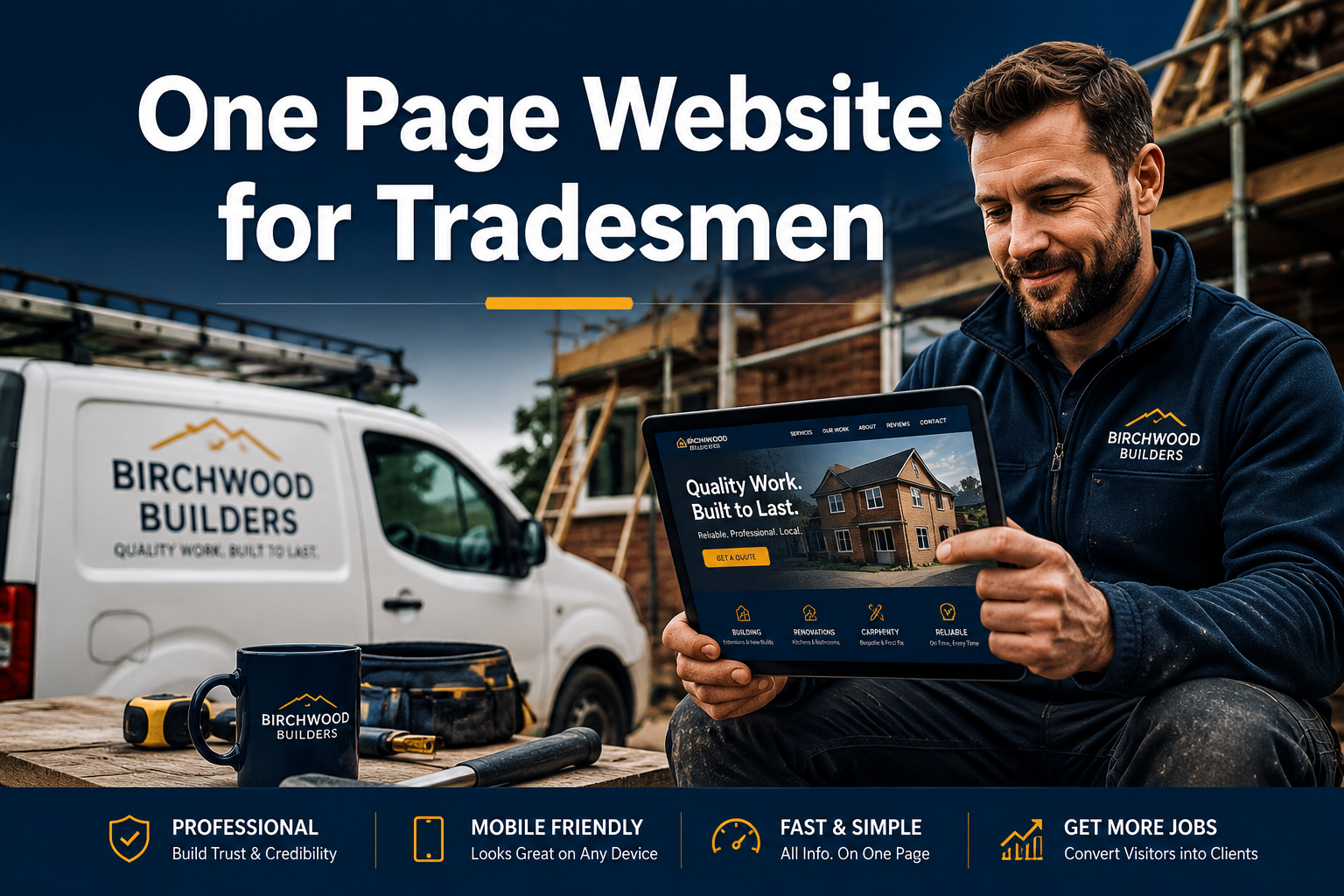
Quick Answer: A one page website for tradesmen is a single-scroll website that presents everything a potential customer needs — services, credentials, reviews, and a contact form — without the complexity of a multi-page site. For most tradesmen, it’s the fastest, most cost-effective way to establish a credible online presence and start generating enquiries.
Key Takeaways
- A one page website for tradesmen covers all the essentials: who you are, what you do, where you work, and how to get in touch.
- It loads faster, costs less to build, and is easier to maintain than a full multi-page website.
- Mobile performance matters most — the majority of local service searches happen on smartphones.
- Clear calls to action (phone number, contact form) are the most important conversion elements on any tradesman’s site.
- Social proof — reviews, before-and-after photos, accreditations — dramatically increases enquiry rates.
- A thoughtfully designed one-pager can rank in local search results when built with basic SEO in mind.
- Most tradesmen don’t need a blog or an online shop to start. A focused, well-built single page is enough to compete.
- Professional design signals trustworthiness before a customer even reads a word.
What Exactly Is a One Page Website for Tradesmen?
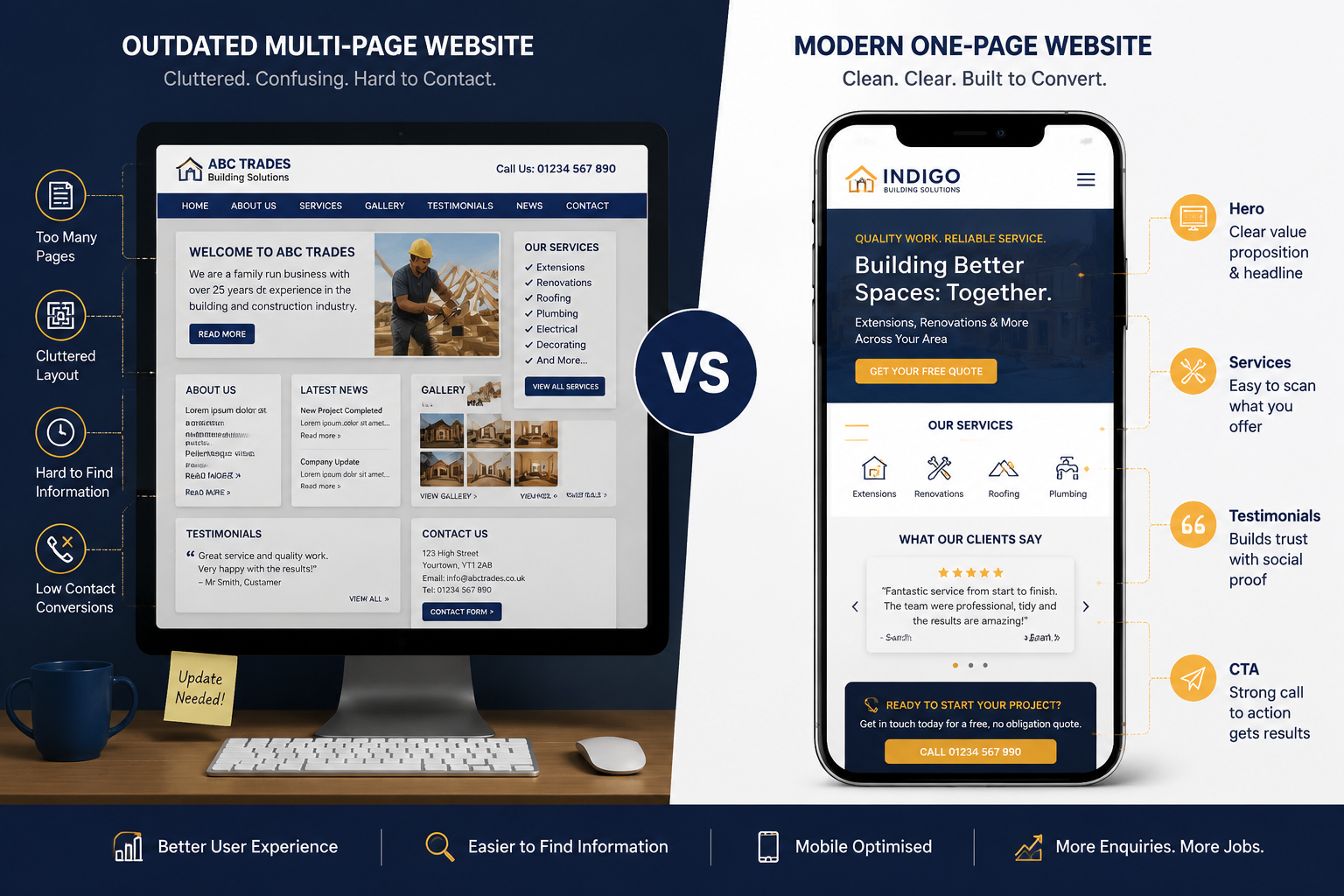
A one page website for tradesmen is a single-scroll site that replaces a full multi-page website. Instead of separate pages for “About”, “Services”, and “Contact”, everything sits on one continuous page that visitors scroll through from top to bottom.
It’s a clear and considered format that works particularly well for sole traders and small trade businesses. Electricians, plumbers, builders, plasterers, decorators — any tradesman who needs a professional online presence without the overhead of a complex website.
What a well-built one-pager typically includes:
- A strong headline that states what you do and where you do it
- A brief introduction or “about” section
- A list of services with short descriptions
- A gallery or portfolio of completed work
- Customer testimonials or review snippets
- Accreditations, certifications, or trade body memberships
- A clear contact section with phone number, email, and a simple form
- A sticky header or floating call button for mobile users
“Confidence in every detail starts before a customer picks up the phone. Your website is the first impression — make it count.”
Why Is a One Page Website a Good Fit for Most Tradesmen?
For tradesmen, simplicity is a strength. Customers searching for a local plumber or electrician aren’t browsing for entertainment — they want to confirm you’re credible, check your services, and get in touch. A single page delivers all of that without friction.
The practical advantages are real:
| Feature | One Page Site | Multi-Page Site |
|---|---|---|
| Build time | 2–4 weeks | 4–10 weeks |
| Setup cost | Lower | Higher |
| Maintenance | Minimal | More involved |
| Mobile performance | Excellent | Varies |
| SEO potential | Good for local | Broader potential |
| Best for | Sole traders, starters | Growing businesses |
Choose a one page website if you’re just starting out, working solo, or simply want a reliable digital presence without ongoing complexity. Consider a multi-page site when you’re ready to target multiple service areas, publish blog content, or build a more extensive brand presence.
A user-friendly website design is one of the most important factors in converting visitors into enquiries — and a focused single page is one of the easiest ways to get that right from the start.
What Should a One Page Website for Tradesmen Include?
The most effective one page websites for tradesmen follow a proven structure. Every section earns its place. Nothing is there for decoration alone.
Section-by-section breakdown:
- Hero section — Your name or business name, what you do, and where you cover. A strong photo of you or your work. One clear call to action: “Call Now” or “Get a Free Quote.”
- Services — A clean list of what you offer. Keep descriptions short. Use icons if the design supports it.
- About — A brief, honest paragraph about your experience, qualifications, and why customers choose you. This builds trust quickly.
- Portfolio or gallery — Before-and-after photos, completed projects, or job site images. Visual proof is powerful.
- Testimonials — Real reviews from real customers. Even three or four well-chosen quotes make a significant difference.
- Accreditations — Gas Safe, NICEIC, TrustMark, Federation of Master Builders — display any relevant logos prominently.
- Contact section — Phone number (large and clickable on mobile), email, and a short contact form. Include your service area.
- Footer — Business name, address (if applicable), links to your Google Business Profile or social pages.
Every section should lead naturally to the next. The page should feel like a confident conversation, not a brochure dump.
How Does a One Page Website Help Tradesmen Get Found on Google?
A thoughtfully designed one page website for tradesmen can rank well in local search results when it’s built with basic SEO in mind. It won’t compete with large directories like Checkatrade overnight, but it gives you a credible, owned presence that works alongside those platforms.
Key local SEO elements to include:
- Your trade and location in the page title and H1 heading (e.g., “Electrician in Stockport”)
- Your service area mentioned naturally in the body copy
- A Google Business Profile linked to the same address and phone number
- Your business name, address, and phone number (NAP) consistent across the web
- Fast loading speed — Google rewards pages that load quickly on mobile
- A secure HTTPS connection (SSL certificate)
For a deeper look at how to strengthen your site’s visibility, on-page SEO strategies for small business websites are worth understanding early. Getting the basics right from the start means your site works harder for you over time.
You can also boost your local SEO ranking by combining your one-pager with an optimised Google Business Profile and a handful of genuine customer reviews.
What Makes a One Page Website for Tradesmen Actually Convert?
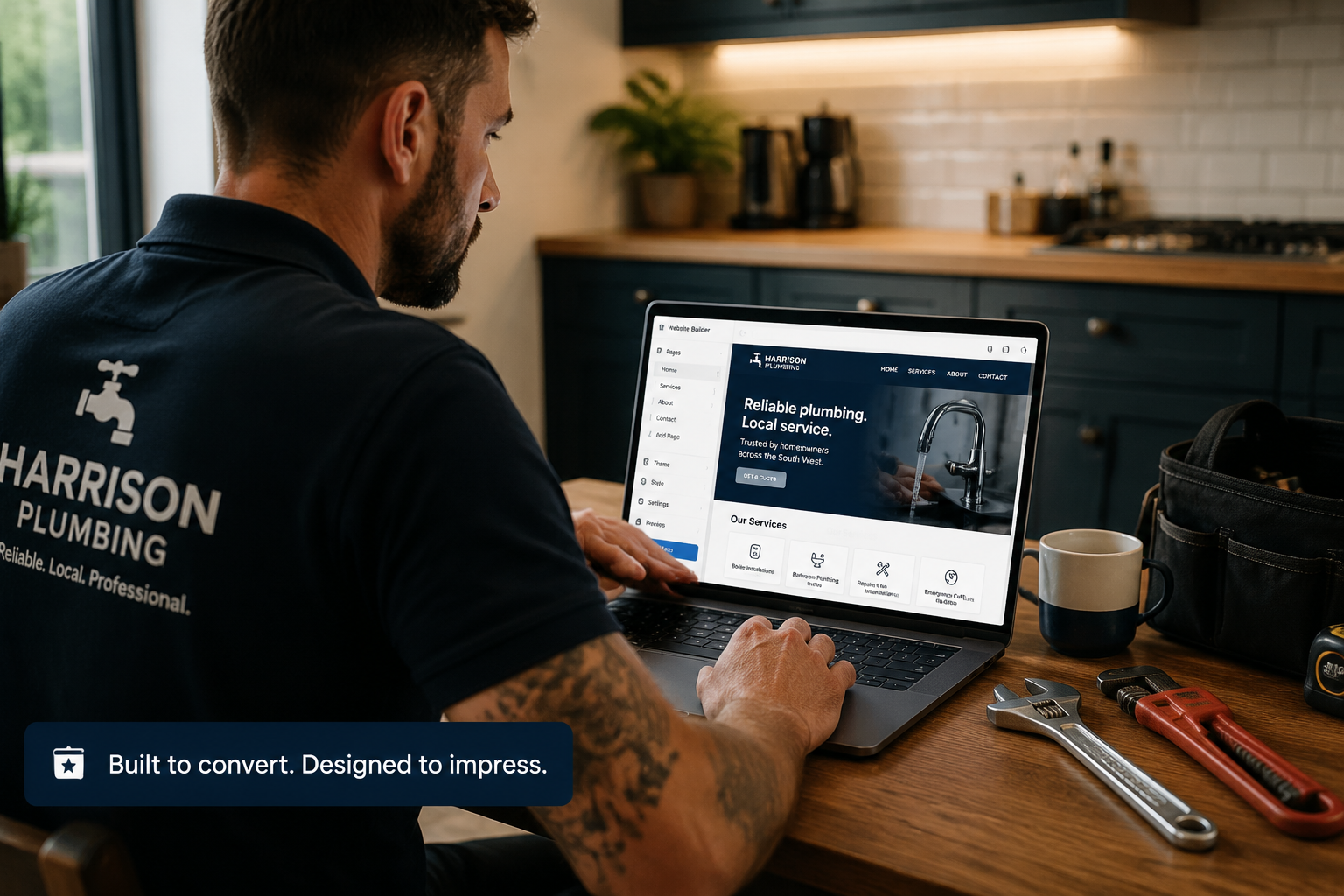
A website that looks good but doesn’t generate enquiries is just an expensive business card. The difference between a site that converts and one that doesn’t usually comes down to a few specific decisions.
The elements that drive conversions:
- Phone number in the header — Visible immediately, clickable on mobile. Don’t make people hunt for it.
- Clear, action-led headline — “Manchester Plumber. Available 7 Days a Week.” beats “Welcome to My Website” every time.
- Social proof above the fold — A star rating or a short testimonial near the top of the page builds instant confidence.
- One primary call to action — Don’t offer five options. Pick one: call, or fill in the form.
- Fast load time — A page that takes more than three seconds to load loses a significant portion of mobile visitors.
- Professional photography — Even a few good photos of your work or your team make a measurable difference to trust.
Understanding what drives landing page conversions applies directly to a tradesman’s one-page site. The same principles — clarity, trust signals, and a single focused action — determine whether a visitor picks up the phone.
How Much Does a One Page Website for Tradesmen Cost in 2026?
Costs vary depending on who builds it and what’s included. Here’s a realistic breakdown for UK tradesmen in 2026.
Typical pricing tiers:
| Option | Approximate Cost | What You Get |
|---|---|---|
| DIY website builder | £10–£30/month | Template-based, limited design control |
| Freelance designer | £300–£800 one-off | Custom design, some SEO setup |
| Web design agency (starter) | £400–£1,000 one-off + monthly hosting | Professional design, SEO, ongoing support |
| Full-service package | £100–£200/month | Site, hosting, maintenance, content, SEO |
Note: These are estimates based on typical UK market rates in 2026. Actual quotes will vary.
A one-time setup charge plus a monthly hosting and maintenance fee is the most common structure for professionally built sites. The monthly element covers security updates, backups, and technical upkeep — so the site stays fast and secure without any effort on your part.
For tradesmen who are starting a small business, a starter website is often the most sensible first investment. It establishes your brand online, costs less than a single day’s lost work, and starts building your digital reputation immediately.
What Are the Most Common Mistakes Tradesmen Make With Their Website?
Even well-intentioned sites can underperform. These are the patterns that come up most often.
- No phone number on mobile — The most common and most costly mistake. If a customer can’t tap to call in two seconds, they’ll call someone else.
- Generic stock photos — Images of anonymous hands holding tools don’t build trust. Real photos of your actual work do.
- No reviews or testimonials — Social proof is essential. A site without it feels unverified.
- Vague service descriptions — “We do all types of work” tells a customer nothing. List your specific services clearly.
- Slow loading speed — Large, uncompressed images are the most common cause. Compress everything before uploading.
- No local signal — If the page doesn’t mention your town or service area, Google has no reason to show it for local searches.
- Outdated design — A site that looks like it was built in 2012 sends the wrong signal about the quality of your work.
For a broader view of what makes a small business website successful, the same principles apply: clarity, credibility, and a clear path to contact.
FAQ
Do tradesmen really need a website if they’re already on Checkatrade or Rated People?
Yes. Third-party directories are useful, but they don’t belong to you. A website gives you a permanent, branded presence that you control. It also helps customers verify you independently, which increases trust.
How long does it take to build a one page website for a tradesman?
A professionally built one-pager typically takes two to four weeks from brief to launch. The timeline depends on how quickly you can provide photos, copy, and feedback.
Can a one page website rank on Google?
Yes, particularly for local searches. A well-optimised one-pager with a linked Google Business Profile can appear in local results for searches like “plumber in [your town].”
Is a one page website better than a multi-page website for a sole trader?
For most sole traders, yes. A focused, well-built single page outperforms a poorly maintained multi-page site. Start simple, then expand when your business demands it.
What platform is best for building a one page tradesman website?
WordPress is the most flexible and widely supported option. It powers a large proportion of websites globally and supports everything from simple one-pagers to full e-commerce sites.
Do I need to update my one page website regularly?
Minor updates — adding new photos, refreshing testimonials, updating service areas — are worth doing occasionally. Technical maintenance (security, backups, plugin updates) should happen monthly, ideally handled by your web designer.
What’s the most important section on a tradesman’s one page website?
The contact section, followed closely by testimonials. Customers arrive ready to enquire — make it effortless for them to do so.
Can I add a one page website to my existing Google Business Profile?
Yes, and you should. Link your website URL directly in your Google Business Profile. Consistency between the two strengthens your local search presence.
Conclusion
A one page website for tradesmen is one of the most practical investments a sole trader or small trade business can make in 2026. It’s modern, focused, and built around what customers actually need: a quick way to verify you’re credible and get in touch.
Actionable next steps:
- Audit your current online presence — Search your business name and your trade plus location. What comes up? Is it accurate and professional?
- Gather your assets — Collect good photos of your work, your certifications, and a handful of customer reviews before briefing a designer.
- Define your service area — Be specific. “Manchester and surrounding areas” is less useful than “Stockport, Didsbury, Cheadle, and Bramhall.”
- Brief a professional — A thoughtfully designed site built around your goals will outperform a template every time. iindigo’s web design services are built for exactly this kind of project.
- Set up or optimise your Google Business Profile — It works alongside your website to improve local visibility.
A well-built one-pager isn’t just a website. It’s a reliable, refined business tool that works for you around the clock — distinctive by design, and made simple enough to get live fast.